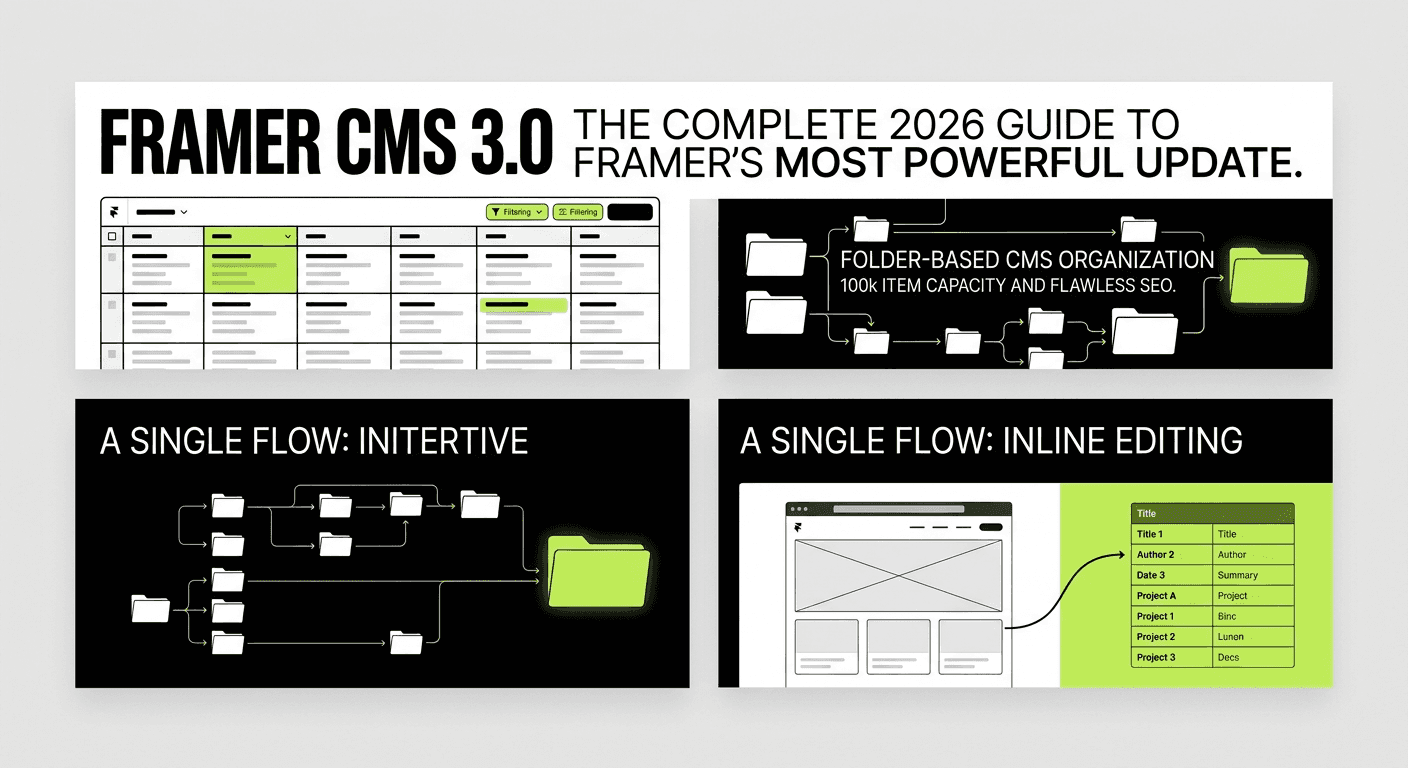

Framer CMS 3.0: The Complete 2026 Guide to Framer's Most Powerful Update Yet
MAR 22, 2024

Khakan Hayder
Founder
15 MINS READ
What Is Framer CMS 3.0?
Framer CMS 3.0 is a fully redesigned content management system integrated directly into the Framer ecosystem. It allows users to manage dynamic content such as blog posts, case studies, portfolios, and product listings without relying on external tools or custom code.
The biggest shift in this version is how content is edited and organized. Instead of relying on pop-up overlays and rigid structures, the new system introduces a fluid, table-based interface that feels closer to working in a spreadsheet. This change alone significantly improves efficiency for teams handling large volumes of content.
What used to take multiple clicks and constant context switching can now be done instantly within a single view.
Key Highlights of Framer CMS 3.0
While the update introduces many improvements, a few core changes define its impact:
Supports up to 100,000 CMS items, making it suitable for large-scale projects
Enables full inline editing without opening separate panels
Allows bulk editing and multi-selection for faster workflows
Introduces folder-based organization for better structure
Enhances filtering and search for precise content management
Requires zero coding, keeping it accessible for non-technical users
These improvements collectively transform the CMS from a design-friendly tool into a scalable content engine.
A New Editing Experience
The most noticeable improvement in Framer CMS 3.0 is the editing interface. Previously, users had to open individual items in overlays to make changes, which slowed down workflows significantly. In the new version, everything happens directly within a table layout.
This means editors can update text, images, references, and publishing statuses without leaving the main view. The experience feels immediate and responsive, allowing content teams to move faster and with fewer interruptions.
For organizations managing large content libraries, this shift dramatically reduces the time required for routine updates.
Bulk Editing That Actually Saves Time
Bulk editing has been redesigned to support real-world workflows. Instead of making repetitive changes one item at a time, users can now select multiple entries and apply updates simultaneously.
This is particularly useful when handling SEO updates, content migrations, or category changes. A task that previously required hours can now be completed in minutes, making the CMS far more practical for growing businesses and agencies.
Better Organization With Collection Folders
As websites expand, content structures become more complex. Framer CMS 3.0 introduces folders for collections, allowing teams to group related content types logically.
This change might seem simple, but it has a significant impact on usability. Instead of navigating through a flat and cluttered list, users can now organize their CMS in a way that reflects their actual site architecture. This makes managing large projects far more intuitive and reduces confusion for teams working collaboratively.
Smarter Search and Filtering
Another major improvement is the ability to combine search with advanced filtering. This allows users to quickly locate specific content, even within large datasets.
For example, a content manager can instantly find published blog posts missing meta descriptions or identify entries that need updates. This level of precision makes the CMS far more efficient and aligns it with the needs of modern content operations.
Customizable Workflow Experience
Framer CMS 3.0 gives users more control over how they interact with their content. Columns can be resized and reordered, allowing teams to prioritize the information that matters most to them.
This flexibility turns the CMS into a personalized workspace rather than a fixed system. Different teams can adapt the interface to match their workflow, whether they are focused on publishing, SEO, or product management.
SEO Advantages of Framer CMS 3.0
Search engine optimization remains one of Framer’s strongest advantages, and this update enhances it even further. The CMS allows dynamic generation of meta titles, descriptions, and structured data directly from content fields.
Because Framer sites are built with performance in mind, they often achieve high scores in speed and accessibility, which directly impacts search rankings. The integration of CMS and design ensures that dynamically generated pages maintain the same performance standards as static pages.
With inline editing, SEO tasks become significantly faster. Content teams can update metadata across multiple entries without leaving the main interface, streamlining optimization efforts.
Dynamic Content and SEO Scalability
Framer CMS also supports dynamic filtering and URL-based content variations, which play an important role in modern SEO strategies. This allows websites to create multiple indexable pages based on categories, tags, or filters without duplicating content.
As a result, businesses can expand their search visibility while maintaining a clean and structured site architecture.
Framer CMS 3.0 vs Traditional CMS Platforms
When compared to traditional CMS platforms, Framer CMS 3.0 stands out for its unified approach. While platforms like WordPress or headless CMS solutions often separate design and content management, Framer combines both into a single environment.
This eliminates the need for complex integrations and reduces reliance on developers for routine updates. For teams that prioritize speed and collaboration, this unified system offers a clear advantage.
Real-World Applications
Framer CMS 3.0 is versatile enough to support a wide range of use cases. Marketing teams can manage blogs and landing pages more efficiently, while agencies can deliver client-friendly CMS experiences that require minimal training.
SaaS companies benefit from scalable content structures for features, updates, and documentation. Creators and portfolio owners can manage large collections of projects with ease, using bulk actions to maintain consistency across their work.
What This Means for the Future of CMS
The release of Framer CMS 3.0 reflects a broader shift in the industry. Content management systems are no longer just databases; they are becoming integrated platforms that combine design, performance, and scalability.
This update highlights several important trends:
No-code tools are evolving into enterprise-ready solutions
AI and automation are becoming standard in content workflows
Speed and efficiency are critical for competitive advantage
Framer is positioning itself at the center of these changes by offering a platform that balances simplicity with power.
Why Expertise Still Matters
Although Framer CMS 3.0 simplifies many aspects of content management, building a high-performing website still requires expertise. Structuring collections, optimizing performance, and designing scalable systems are tasks that benefit from professional experience.
I am an experienced Framer developer who specialize in creating fast, visually compelling, and SEO-optimized websites. From designing CMS architectures to implementing dynamic content strategies, I help businesses fully leverage the capabilities of Framer.
Working with a specialist ensures that the platform is used to its full potential, allowing teams to focus on growth rather than technical challenges.
Final Thoughts
Framer CMS 3.0 is the most significant update the platform has introduced to date. By focusing on speed, usability, and scalability, it transforms the CMS into a powerful tool for modern teams.
The shift to inline editing, improved organization, and faster workflows makes content management more efficient and intuitive. Combined with strong SEO capabilities and a unified design environment, Framer CMS 3.0 sets a new standard for what a no-code CMS can achieve.
For businesses looking to build and scale high-quality websites in 2026, this update makes Framer one of the most compelling choices available.
Framer CMS 3.0 is a fully redesigned content management system integrated directly into the Framer ecosystem. It allows users to manage dynamic content such as blog posts, case studies, portfolios, and product listings without relying on external tools or custom code.
The biggest shift in this version is how content is edited and organized. Instead of relying on pop-up overlays and rigid structures, the new system introduces a fluid, table-based interface that feels closer to working in a spreadsheet. This change alone significantly improves efficiency for teams handling large volumes of content.
What used to take multiple clicks and constant context switching can now be done instantly within a single view.
Key Highlights of Framer CMS 3.0
While the update introduces many improvements, a few core changes define its impact:
Supports up to 100,000 CMS items, making it suitable for large-scale projects
Enables full inline editing without opening separate panels
Allows bulk editing and multi-selection for faster workflows
Introduces folder-based organization for better structure
Enhances filtering and search for precise content management
Requires zero coding, keeping it accessible for non-technical users
These improvements collectively transform the CMS from a design-friendly tool into a scalable content engine.
A New Editing Experience
The most noticeable improvement in Framer CMS 3.0 is the editing interface. Previously, users had to open individual items in overlays to make changes, which slowed down workflows significantly. In the new version, everything happens directly within a table layout.
This means editors can update text, images, references, and publishing statuses without leaving the main view. The experience feels immediate and responsive, allowing content teams to move faster and with fewer interruptions.
For organizations managing large content libraries, this shift dramatically reduces the time required for routine updates.
Bulk Editing That Actually Saves Time
Bulk editing has been redesigned to support real-world workflows. Instead of making repetitive changes one item at a time, users can now select multiple entries and apply updates simultaneously.
This is particularly useful when handling SEO updates, content migrations, or category changes. A task that previously required hours can now be completed in minutes, making the CMS far more practical for growing businesses and agencies.
Better Organization With Collection Folders
As websites expand, content structures become more complex. Framer CMS 3.0 introduces folders for collections, allowing teams to group related content types logically.
This change might seem simple, but it has a significant impact on usability. Instead of navigating through a flat and cluttered list, users can now organize their CMS in a way that reflects their actual site architecture. This makes managing large projects far more intuitive and reduces confusion for teams working collaboratively.
Smarter Search and Filtering
Another major improvement is the ability to combine search with advanced filtering. This allows users to quickly locate specific content, even within large datasets.
For example, a content manager can instantly find published blog posts missing meta descriptions or identify entries that need updates. This level of precision makes the CMS far more efficient and aligns it with the needs of modern content operations.
Customizable Workflow Experience
Framer CMS 3.0 gives users more control over how they interact with their content. Columns can be resized and reordered, allowing teams to prioritize the information that matters most to them.
This flexibility turns the CMS into a personalized workspace rather than a fixed system. Different teams can adapt the interface to match their workflow, whether they are focused on publishing, SEO, or product management.
SEO Advantages of Framer CMS 3.0
Search engine optimization remains one of Framer’s strongest advantages, and this update enhances it even further. The CMS allows dynamic generation of meta titles, descriptions, and structured data directly from content fields.
Because Framer sites are built with performance in mind, they often achieve high scores in speed and accessibility, which directly impacts search rankings. The integration of CMS and design ensures that dynamically generated pages maintain the same performance standards as static pages.
With inline editing, SEO tasks become significantly faster. Content teams can update metadata across multiple entries without leaving the main interface, streamlining optimization efforts.
Dynamic Content and SEO Scalability
Framer CMS also supports dynamic filtering and URL-based content variations, which play an important role in modern SEO strategies. This allows websites to create multiple indexable pages based on categories, tags, or filters without duplicating content.
As a result, businesses can expand their search visibility while maintaining a clean and structured site architecture.
Framer CMS 3.0 vs Traditional CMS Platforms
When compared to traditional CMS platforms, Framer CMS 3.0 stands out for its unified approach. While platforms like WordPress or headless CMS solutions often separate design and content management, Framer combines both into a single environment.
This eliminates the need for complex integrations and reduces reliance on developers for routine updates. For teams that prioritize speed and collaboration, this unified system offers a clear advantage.
Real-World Applications
Framer CMS 3.0 is versatile enough to support a wide range of use cases. Marketing teams can manage blogs and landing pages more efficiently, while agencies can deliver client-friendly CMS experiences that require minimal training.
SaaS companies benefit from scalable content structures for features, updates, and documentation. Creators and portfolio owners can manage large collections of projects with ease, using bulk actions to maintain consistency across their work.
What This Means for the Future of CMS
The release of Framer CMS 3.0 reflects a broader shift in the industry. Content management systems are no longer just databases; they are becoming integrated platforms that combine design, performance, and scalability.
This update highlights several important trends:
No-code tools are evolving into enterprise-ready solutions
AI and automation are becoming standard in content workflows
Speed and efficiency are critical for competitive advantage
Framer is positioning itself at the center of these changes by offering a platform that balances simplicity with power.
Why Expertise Still Matters
Although Framer CMS 3.0 simplifies many aspects of content management, building a high-performing website still requires expertise. Structuring collections, optimizing performance, and designing scalable systems are tasks that benefit from professional experience.
I am an experienced Framer developer who specialize in creating fast, visually compelling, and SEO-optimized websites. From designing CMS architectures to implementing dynamic content strategies, I help businesses fully leverage the capabilities of Framer.
Working with a specialist ensures that the platform is used to its full potential, allowing teams to focus on growth rather than technical challenges.
Final Thoughts
Framer CMS 3.0 is the most significant update the platform has introduced to date. By focusing on speed, usability, and scalability, it transforms the CMS into a powerful tool for modern teams.
The shift to inline editing, improved organization, and faster workflows makes content management more efficient and intuitive. Combined with strong SEO capabilities and a unified design environment, Framer CMS 3.0 sets a new standard for what a no-code CMS can achieve.
For businesses looking to build and scale high-quality websites in 2026, this update makes Framer one of the most compelling choices available.